
Step deck vs double drop: which trailer fits your load?
Published
Height decides it. On a Fission step deck, a piece up to 120 inches tall rides legal with no height permit, at up to 45,000 lb. Anything taller goes in the 32 ft well of a double drop, which carries up to 42,000 lb.
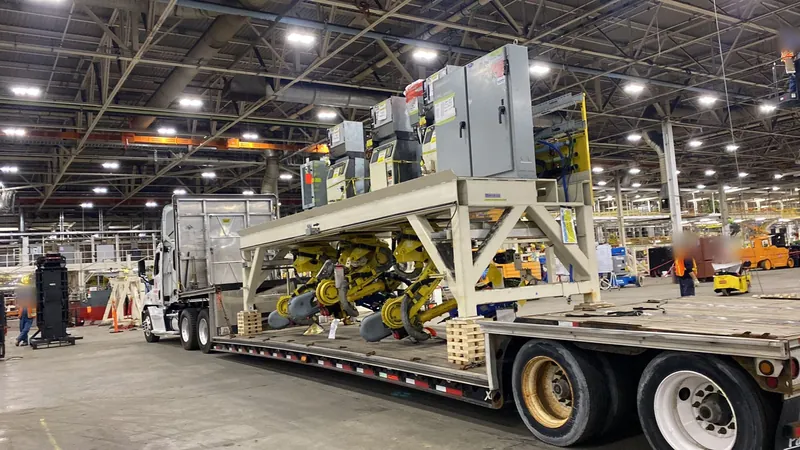
Both trailers exist for the same reason: the freight is too tall for a flatbed. A flatbed deck sits about 5 ft off the road, so anything over 102 inches (8 ft 6 in) tall is past the legal height. A step deck drops the deck. A double drop drops it again. The lower the deck, the taller the piece can be before it needs a permit.
Step deck and double drop side by side
| Check | Step deck | Double drop |
|---|---|---|
| Shape | Short upper deck over the tractor, long lower deck behind it | Short deck at each end, a well in the middle |
| Where the freight rides | Lower deck, 42 inches off the road on our low profile units | The well, the lowest deck we have, 32 ft long |
| Tallest piece | 120 inches (10 ft), legal in Ontario and the US with no permit | Taller than 120 inches, up to 13 ft. Dispatch tells you if it needs a permit |
| Payload | Up to 45,000 lb | Up to 42,000 lb |
| How it loads | Upper deck from a dock. Lower deck by crane, or from the side with a forklift or loader | By crane, or from the side with a forklift or loader |
| Covered option | Curtainside units take 102 inches wide under the curtain | Open or curtainside |
| Fission fleet | 4, all 53 ft | 3, all 53 ft |
The math that picks the trailer
Legal height is 4.15 m in Ontario, about 13 ft 7 in, and 13 ft 6 in in Michigan, Ohio, Pennsylvania and New York. That is measured from the road to the top of the load. Subtract the deck height and what is left is the room for the freight.
- Flatbed: a deck about 5 ft up leaves about 102 inches (8 ft 6 in) for the freight.
- Step deck: 42 inches of deck plus 120 inches of freight is 162 inches, which is exactly 13 ft 6 in. Legal for height on both sides of the border, with no room to spare. At 121 inches it is over in the US.
- Double drop: the well sits lower still, so a piece over 120 inches can still come in under the limit. Send the height and dispatch tells you if it clears.
The full height rules, with the permit steps past the legal limit, are in how tall a load can be in Ontario.
When a step deck is the right call
- The piece is taller than 102 inches (8 ft 6 in) and up to 10 ft, crated or skidded.
- It is too long for the 32 ft well of a double drop.
- It weighs more than 42,000 lb and up to 45,000 lb.
- Part of the load can go on the upper deck from a dock.
A real one: a 120 inch crate on a step deck, quoted and booked the same morning with no permit.
When it has to be a double drop
- The piece is taller than 120 inches and fits in a 32 ft well.
- It weighs 42,000 lb or less.
- The plant has a crane, or room to load from the side.
Presses, production cells, tall machine tools and tanks are the usual double drop loads. If a piece is too tall even for the well, it moves on a permit with the route checked for bridges and wires, and dispatch handles that in house. See oversize load trucking.
3 things that change the answer
- The crated height. A skid usually adds 4 to 6 inches and a crate lid adds more. A 116 inch machine on a skid can be a 122 inch load, and that moves it from a step deck to a double drop.
- What comes off. Guards, stacks, lights and lifting eyes often decide it. Shipped separately, a piece that needed a double drop may ride on a step deck.
- How it loads at both ends. We do not carry ramps. Tell dispatch whether each end has a crane, a forklift, a loader or a dock, and we send a trailer that works at both.
Is a double drop the same as a lowboy?
Close, but not the same. Lowboy usually means a heavy equipment trailer with a removable gooseneck that loads from the front. Our double drops carry up to 42,000 lb in a 32 ft well and load by crane, or from the side with a forklift or loader.
What to send for a quote
Send the height from the bottom of the skid or crate to the highest point, the length, the width, the weight, both addresses and how it loads at each end. Dispatch names the trailer with the price. Both trailers cross at Detroit and Buffalo, and they run out of Mississauga with the rest of the fleet. The trailer details are on step deck and double drop, and the freight that rides on them is on machinery and dies. Request a quote or call dispatch at (905) 799 7900, press 1.
Questions shippers ask
What is the difference between a step deck and a double drop?
A step deck has a short upper deck over the tractor and a long lower deck behind it. A double drop has a short deck at each end and a 32 ft well in the middle that sits lower. Ours take freight up to 120 inches tall and 45,000 lb on the step deck, and taller pieces up to 42,000 lb in the double drop.
When do I need a double drop instead of a step deck?
When the piece is taller than 120 inches. It rides in the 32 ft well, the lowest deck we have, and dispatch tells you if it still needs a permit.
Which carries more, a step deck or a double drop?
The step deck. Ours carry up to 45,000 lb, and our double drops carry up to 42,000 lb.
Is a step deck the same as a drop deck?
Yes. Drop deck and single drop are other names for a step deck. The deck steps down once behind the tractor, and the freight rides on the long lower section.
Sources: the Highway Traffic Act, section 109, for Ontario's legal height, and state vehicle height limits. Deck heights, well length and payloads are Fission's own equipment. Other carriers' trailers differ, so confirm the deck height with whoever hauls the load.
More from the yard
Need a truck this week?
Send the lane and the weight. A dispatcher prices it within 1 business hour, and someone picks up the phone 24 hours a day.