
How to move industrial machinery between plants
Published
A machine move has three parties: the rigger who lifts it, the carrier who drives it, and the receiving plant that sets it down. The trucking part goes right when the carrier gets the crated height, the weight and the tie down points before the truck is booked, and the trailer is picked from those numbers.
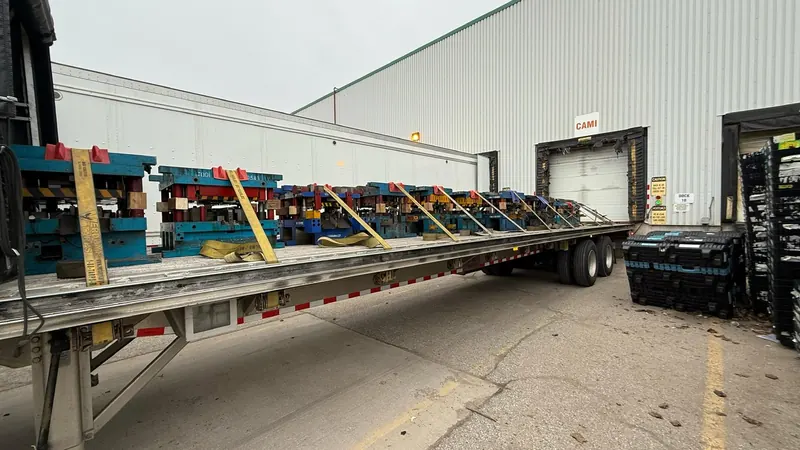
Most of the planning for a plant move goes into the rigging and the install. The trucking part is shorter, but it is where a move gets stuck: a piece turns out taller than the trailer can carry legally, or it arrives at a dock that has no way to lift it off. Both are avoidable. This is how the trucking part works, piece by piece.
Who does what
| Step | Who | What happens |
|---|---|---|
| Disconnect, drain, crate or wrap | The plant or its rigger | Power, air and fluids disconnected. Loose parts boxed. Finished surfaces wrapped. Lifting points marked. |
| Measure and weigh | The plant or its rigger | Length, width and height as it will ride, with the crate, skid or wrap on. Weight of each piece. |
| Pick the trailer, pull any permits | Carrier dispatch | Trailer chosen from the height and weight. Permits for anything over width or over height. |
| Lift it on | The rigger | From a dock, with a forklift or loader, or by crane. Fission does not carry ramps or lift gear, and most flatbed carriers do not. |
| Chain and block | The driver | Chained at the lifting or tie down points, blocked front and rear, belting under chains on finished surfaces. |
| Lift it off | The receiving plant or its rigger | The driver calls ahead so the lift is ready when the truck arrives. |
The two handoffs that matter are the measurements going to dispatch before booking, and the lift being ready at both ends.
Which trailer the piece rides on
In Ontario a loaded truck can be 4.15 m tall, about 13 ft 7 in, and 2.6 m wide, 8 ft 6 in, without a permit. A flatbed deck sits about 5 ft off the road, so a flatbed carries a piece up to about 8 ft 6 in tall. Above that the piece needs a lower deck or a permit.
| Crated height | Trailer | Payload | Note |
|---|---|---|---|
| Up to 102 inches | Conestoga, 53 ft | Up to 45,000 lb | Rides dry under the cover. Up to 102 inches wide as well. |
| Up to about 8 ft 6 in | Open flatbed, 53 ft | Up to 45,000 lb | Tarped on request, or shrink wrapped by the shipper. |
| Up to 120 inches | Step deck, 53 ft | Up to 45,000 lb | Lower deck 42 inches off the road, so 120 inches rides legal with no permit. |
| Over 120 inches | Double drop, 53 ft | Up to 42,000 lb | Rides in the 32 ft well. Dispatch tells you if it still needs a permit. |
| Legal height, too heavy for a tandem | 6 axle curtainside, 50 ft | Up to 86,000 lb | Inside Ontario and into Michigan. 76,000 lb into Ohio and Indiana. For press parts and bases a tandem cannot carry legally, within legal width and height. |
The weight decides between a tandem and a multi axle. The height decides between a flatbed, a step deck and a double drop. Width over 8 ft 6 in adds a permit on any of them. More on the width rules in how wide a load can be in Ontario, and the deck heights are on the step deck and double drop page.
A line in several pieces
A production line or a cell rarely moves as one piece. Send the full list before the first truck is booked: each piece with its crated size, weight and the order the install crew wants them to arrive. Dispatch then matches pieces to trailers and plans the trucks in that order, so the base shows up before the head and the control cabinets do not arrive a day before anything to connect them to.
Pieces that can get wet ride on open decks. Control cabinets, robots and machine tools ride in a Conestoga or under shrink wrap. If one piece is too tall for the cover and the rest are not, that piece goes on a step deck and the rest go together.
Cross border moves
A machine going between an Ontario plant and one in Michigan, Ohio or Indiana crosses at Detroit or Buffalo. Your customs broker clears the machine. The carrier files the ACE or ACI eManifest before the truck reaches the bridge, and the broker needs the commercial invoice and the shipper and consignee details ahead of time, and classifies the machine from the invoice description. A used machine moving between plants of the same company still clears customs like any other import, so the broker should be in the loop before the move date, not the day of.
Oversize rules change at the border. The US federal width limit on the National Network is the same 8 ft 6 in, but each state sets its own permit and travel rules, so a piece that is legal in Ontario can need a permit in Michigan. Dispatch pulls the state permits before the truck leaves.
What to send the carrier
- What each piece is, and how many pieces
- Crated length, width and height of each, measured at the widest and tallest points with everything bolted on
- Weight of each piece
- Where the lifting or tie down points are, with a photo or drawing
- How it loads and how it comes off at the other end: dock, forklift, loader or crane
- Both addresses, the ready date and the order the pieces should arrive in
With those six, dispatch names the trailer for each piece and prices a legal load within 1 business hour, 7 am to 5 pm ET, Monday to Friday. A piece that needs a permit is priced after the route check. The full checklist is in what to send for a fast quote.
How Fission moves machinery
We run machinery and dies plant to plant out of Mississauga, across Ontario and Quebec and into the US, on 4 step decks, 3 double drops, 90 Conestogas and 6 axle units for the heavy pieces. Permits are pulled in house. For weekend and shutdown window moves, see planning die moves around a shutdown. Dispatch answers 24 hours, and the receiving plant can get a Samsara link to watch the truck come in. Request a quote or call (905) 799 7900, press 1.
Questions shippers ask
How tall can a machine be without a permit in Ontario?
On a step deck, up to 120 inches, because the lower deck sits 42 inches off the road and the legal height is 4.15 m, about 13 ft 7 in. On a flatbed, about 8 ft 6 in. Taller pieces ride in the well of a double drop.
Does the trucking company load the machine?
No. The plant or its rigger lifts the piece on and off, from a dock, with a forklift or loader, or by crane. The driver chains and blocks it once it is on the deck.
Can a machine ride dry without a tarp?
Yes, if it fits under a Conestoga cover: up to 102 inches tall and wide. Taller pieces can ride on a curtainside step deck, or tarped or shrink wrapped on an open deck.
What does a machine move between Ontario and a US plant need?
A customs broker on your side with the commercial invoice and the shipper and consignee details, and a carrier that files the ACE or ACI eManifest before the bridge. Oversize pieces also need a permit from each state on the route.
Sources: Ontario Highway Traffic Act, section 109 (width and height limits) and section 110 (permits), and the MTO guide to oversize and overweight vehicles and loads. Deck heights and payloads are Fission's own equipment. Rules change, so the permit always governs the move.
More from the yard
Need a truck this week?
Send the lane and the weight. A dispatcher prices it within 1 business hour, and someone picks up the phone 24 hours a day.