
Road salt and tarping: keeping steel coil dry in winter
Published
From November to March, Ontario highways run wet with salt. That salt reaches coil and aluminum on an open deck, so most of ours ride under a closed roof instead of a tarp.
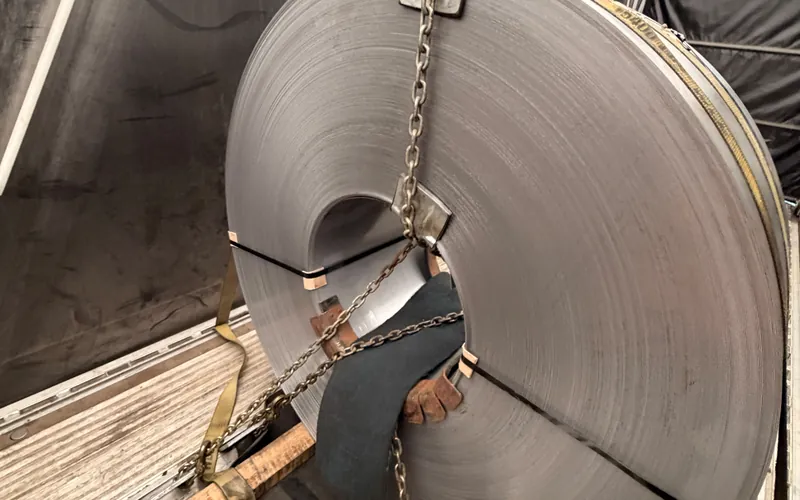
The Ontario Ministry of Transportation says its crews spread salt to stop snow and ice sticking to the pavement and spray anti icing liquid before a storm. From the first freeze to the spring thaw, the 400 series highways and the border crossings are wet with salt water for weeks at a time. Every truck ahead of yours throws that spray back onto an open deck.
Does road salt damage steel coil in transit?
It can. Road salt is mostly chloride, and chloride makes steel rust faster than plain water does. Salt spray lands on the coil, the water dries off and a film of salt stays behind. Salt pulls moisture out of the air, so the film stays damp long after the road has dried.
How much it matters depends on the product. Hot rolled coil with mill scale is often headed for pickling or blasting, and it often rides on an open deck. Cold rolled and galvanized coil are different. The surface is the product. A rust stain on cold rolled, or a white bloom on galvanized, is a rejected coil or a downgrade. Aluminum does not rust, but it stains, and a stained bundle of extrusions is a claim.
What happens to a wet tarped coil
A tarp keeps rain and snow off the top of the load. It does little about spray coming up from the road, and it does nothing about condensation.
Condensation is the winter problem shippers see most. A coil that sat outside at minus 10 is loaded, tarped and driven a few hours. The air under the tarp warms up and the cold steel sweats. Or a warm coil from the mill goes under a cold tarp. The moisture it gives off condenses on the underside of the tarp and drips back onto the steel. Either way the tarp holds the water against the surface, and nothing dries.
What that looks like on arrival:
- Galvanized: white rust. The zinc coating corrodes where water sits on it without air moving over it, and it shows as a chalky white stain. It is cosmetic at first, but it eats the coating that was meant to protect the steel.
- Cold rolled: orange rust stains on the outer wraps and the coil edges, and water that wicks between laps and stains the inside of the coil too.
- Aluminum: water staining, a white or grey mark that does not wipe off, worst where bundles touch and the water cannot escape. On mill finish extrusions it is usually a reject, and anodized is not immune.
Then there is the tarp itself. A frozen tarp dragged over a coil edge or a bundle of extrusions marks the finish.
Tarp or Conestoga in winter?
Both cover the top. The difference is what touches the freight and what gets in from below and from the sides.
On a Conestoga the roof and curtains close around the whole load. Salt spray from the road stays outside the curtain instead of landing on the steel. No tarp touches the coil. The coil sits in racks on timbers, with waterproof paper and rubber belting between the timber and the steel if you spec it, so air can move around it. For cold rolled, galvanized and aluminum from November to March, that is the trailer to ask for. See our Conestoga trucking page.
A tarped flatbed still has a place in winter. Long structural steel, rebar, pipe and anything over 102 inches tall or wide does not fit under a Conestoga roof, and some of it does not care about salt. If the load needs a tarp, the driver tarps it after it is chained. See tarped flatbed trucking. For the comparison of the 2 trailers outside of winter, read when a Rolltite beats a flatbed.
A Conestoga is not a heated box. A frozen coil uncovered on a warm plant floor will sweat there too. The trailer keeps the salt, the rain and the tarp off the steel. The receiving dock is yours to plan.
What to put on the bill of lading or the order
Dispatch can only protect what the order says. For finish sensitive steel and aluminum in winter, write it out:
- "Must arrive dry. Conestoga required." Or, if the load is too tall for a Conestoga, "Tarp required, no tarp contact on coil edges."
- The product: cold rolled, galvanized, aluminum extrusions, anodized. Hot rolled usually does not need the note. Galvanized does.
- Coil position and packaging: eye to side, eye to sky, slit on pallets, paper wrapped or bare.
- Dunnage you want: waterproof paper and belting between the timber and the steel.
- Any receiving instruction, such as keeping the cover closed until the crane is ready.
The same notes belong in the quote request, because they decide which trailer we send. The fast quote checklist covers the rest.
How Fission runs steel and aluminum in winter
Fission Logistics runs 80 trucks and 140 trailers out of Mississauga. 106 of those trailers are Conestogas or multi axle curtainsides: 90 Rolltite Conestogas on 53 ft tandems, and 16 multi axle curtainsides for heavy loads, mostly inside Ontario. The Rolltite clears loads up to 102 inches tall. Most coil and aluminum we move rides under a closed roof and curtain with no tarp touching the steel. Our 10 open flatbeds carry tarps, chains and coil racks, and the driver tarps the load when the freight needs it.
How coil rides in the racks, with paper and belting, is on the steel coil transport page. Extrusions and ingots, strapped and never chained, are on the aluminum extrusion and ingot transport page. For who moves steel in the province, see steel transport companies in Ontario.
Getting a winter quote
Send the product, the weight, the dimensions, the lane and the note that it must arrive dry. Dispatch answers within 1 business hour, 7 am to 5 pm ET, Monday to Friday, and names the trailer with the price. Dispatch runs 24 hours. Get a quote.
Questions shippers ask
Does road salt damage steel coil in transit?
It can. Road salt is mostly chloride, which makes steel rust faster than plain water does, and the salt film stays damp long after the road has dried. Cold rolled, galvanized and aluminum suffer most, because the surface is the product.
Does a tarp keep coil dry in winter?
Not fully. A tarp keeps rain and snow off the top of the load, does little about spray from the road and does nothing about condensation. It holds the water against the surface, and nothing dries.
What should I write on the order for coil in winter?
Write that it must arrive dry and that a Conestoga is required. Add the product, the coil position and packaging, and the dunnage you want, such as waterproof paper and belting between the timber and the steel.
Sources: How we clear Ontario’s highways in winter (Ontario Ministry of Transportation). Product notes are general. Ask your mill or supplier for the storage and handling guidance on your grade and finish.
More from the yard
Need a truck this week?
Send the lane and the weight. A dispatcher prices it within 1 business hour, and someone picks up the phone 24 hours a day.